
29/09/2026 – Auma
Eight trends in the German trade fair industry
“The German Trade Fair Industry: Resilient in Turbulent Times” is the title of the annual publication “Trends 2026/2027” by the Association of the German Trade Fair Industry (Auma). Based on discussions, analyses and observations, Auma has identified eight key trends.
Under the title “The German Trade Fair Industry: Resilient in Turbulent Times,” AUMA presents its “Trends 2026/2027.” © Auma
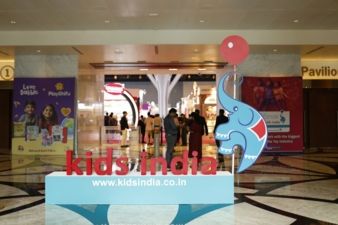
International platforms are strategically used to drive growth, exports and reach new target groups. © Kids India
At Auma, a 25-person team continuously monitors developments in the trade fair industry. Through direct dialogue with exhibitors, visitors, organisers, as well as stakeholders in politics and the media, the team builds a practical picture of the market. From this, Auma identifies eight key trends.
1. Data moves into practice: Activities, projects and budgets will increasingly be justified in 2027 through robust, sales-oriented metrics. Qualified contacts, leads, access to decision-makers and their impact over weeks and months will matter more than subjective impressions. The trend is moving away from “it was a good event” towards KPI systems, CRM integration and comparable analyses. Those unable to provide this will find it harder to compete internally with seemingly precisely measurable digital channels.
2. The dual strategy is becoming the norm: Companies are increasingly securing their core business through regional proximity and cost-efficient formats, while using international platforms strategically for growth, exports and new target groups. In 2027, this two-track approach will become the norm because it distributes risk: stability is organised locally, while scaling is pursued where demand arises – also as a counterbalance to weaknesses in domestic markets.
3. Efficiency and precision are becoming the key to success: Rising costs and greater budget pressure are leading companies to prioritise participation and activities more rigorously, plan more selectively and scrutinise economic viability more consistently. In 2027, activity levels will often remain stable, but they will become more strategic: less “being there”, more selectivity and greater adaptation of concepts with the expectation that the contribution to business success can be demonstrated.
4. Internationality remains an advantage, but is becoming more fragile: High international shares are increasingly caught between geopolitics, travel costs, infrastructure and regulation. For 2027, this means across industries: global reach is valuable, but no longer a given. Access, mobility, frictionless processes and reliable conditions are becoming competitive factors – and risks when they are lacking.
5. Sustainability is becoming evidence-based and circular: The circular economy is gaining importance because it makes material and resource flows systematically measurable, creating transparency and providing a basis for efficiency gains and credible improvements. At the same time, pressure for reliable sustainability communication will increase in 2027: claims must be substantiated, transparently worded and often independently verifiable. Those unable to meet these requirements face reputational and regulatory risks.
6. Resilience is becoming a product requirement: The ability to remain operational, adapt quickly and create trust is becoming increasingly important, particularly in economically and politically turbulent times. Places and formats that enable personal exchange, orientation and business even when conditions become challenging will gain strategic importance. In 2027, however, resilience will not just be about culture; it will also be operational: less friction through efficient processes, digital procedures and reliable infrastructure. Otherwise, resilience risks becoming a marketing buzzword without substance.
7. Security is becoming a growth driver: The changing global situation is driving growth in platforms and offerings related to civil protection, defence, IT security and critical infrastructure, while existing sectors are developing new areas of focus. In 2027, security will act as a cross-industry driver of procurement and innovation: requirements are rising, cooperation is increasing, and capabilities that were previously niche are becoming more visible.
8. AI transformation is moving into the engine room: The focus is shifting away from isolated tools towards integrated systems, collaborative data structures and clearly defined responsibilities across IT, marketing and sales. In 2027, the key question will no longer be whether AI is being used, but whether it delivers economic value. Quick wins such as multilingual assistance, intelligent matchmaking and sales support will gain traction where the cost-benefit ratio can be demonstrated and processes measurably improved. The guiding principle remains pragmatic: realistic feasibility instead of AI theatre.